

Learn how this former hospital, vacant for 30 years, is being transformed into a hotel, conference and architecture center. The tour includes 13 numbered Stops and proceeds clockwise around the South Lawn from the raised campus map.
Welcome
Welcome to the Richardson Olmsted Campus
Location: At Raised Map
This audio tour will guide and inform you as you make your way along the South Lawn, exploring the exterior of this impressive mental health facility built in the 19th century, once known as the Buffalo State Asylum for the Insane. We will introduce you to H. H. Richardson, the building’s architect; Fredrick Law Olmsted and Calvert Vaux, the landscape architects; and Dr. Thomas Story Kirkbride, the creator of the Kirkbride Plan of hospital design for care of those with mental illness. In addition, you’ll learn how, after thirty years of vacancy, this former hospital is being transformed for mixed use as a hotel, conference center, public park and architecture center.
How to Navigate Your Tour
Thirteen numbered locations, called “Stops,” comprise the tour. As the narrative for each Stop ends, you will be directed to the next Stop.
To help you maintain your directional bearings, this tour will take you clockwise around the South Lawn starting at this raised map of the Richardson Olmsted Campus in front of the Towers Building. Directly in front of you is The Richardson Hotel and Bar. Beyond the building to the north is Buffalo State College, Grant Street is to the West, the still-functioning Buffalo Psychiatric Center and Elmwood Avenue are to the East, and Forest Avenue is to the South.
To begin your tour, please walk to the benches in front of the Towers Building.
STOP 1: The Richardson Olmsted Campus
Stop Number 1 - Welcome to the Richardson Olmsted Campus
Location: Benches in front of Towers Building
The Richardson Olmsted Campus represents some of the greatest ideas in architecture, landscape, and mental health treatment practiced in the 1800s.
The building’s architect, H. H. Richardson, is internationally known for what became his signature style, Richardsonian Romanesque. But it was here, at the largest commission ever designed by him, that the style named for him first began to evolve. Richardsonian Romanesque was the first style of architecture to be named after an American. Richardson’s work would later inspire other famous American architects such as Louis Sullivan and Frank Lloyd Wright!
The partners who designed the original 203 acres of this Campus, Fredrick Law Olmsted and Calvert Vaux, are famous for their design of Central Park in New York City. They also created Buffalo’s six Olmsted parks and parkway system, the grounds here, as well as parks in several other American cities. Olmsted himself called Buffalo, “the best planned city, as to its streets, public places, and grounds, in the United States, if not in the world”. Thanks to their partnership, Buffalo enjoys vast recreational green spaces throughout the city.
Dr. Thomas Story Kirkbride was a physician and respected superintendent of the Pennsylvania Hospital for the Insane in West Philadelphia. Inspired by the humane treatment of people with mental illness that he had witnessed at a small Quaker Friends asylum, he created comprehensive guidelines for how to build and run mental institutions. His 1854 work, On the Construction, Organization, and General Arrangements of Hospitals for the Insane is considered the first scientific-architectural response to mental health care. Design of this hospital was based on these guidelines, called the Kirkbride Plan, which would for several decades inspire additional changes in the treatment of mental health.
Everyone involved in this project believed in the progressive idea that the manmade environment could deeply affect mental health, to the point of curing mental illness. This was the shared philosophy that resulted in building the original asylum and which today makes the Richardson Olmsted Campus significant not only for its architecture and landscape but also for how well it exemplified the Kirkbride Plan. 73 Kirkbride asylums were constructed during the 19th century, and Buffalo’s is one of the best-preserved examples of this revolutionary treatment style.
To continue the tour, go closer to the Towers Building in view of the cornerstone in the bottom right hand corner of the building.
STOP 2: Important Construction Numbers and Dates
Stop Number 2—Important Construction Numbers and Dates
Location: On path across from cornerstone
The carved Medina sandstone cornerstone you see across the roadway shows 1872 as the year in which construction of the hospital started. Actually, construction started in 1871, and 1872 represents the date on which the cornerstone was laid. But notice that there are two dates, one of which is different from all those already mentioned. Can you figure out what the date 5872 means? Do you recognize the symbol at the top of the cornerstone? The symbol at the top is a tool of the stonemasons, and it is used by the Freemason group. Freemasons count the years differently than the Western calendar, so the date 5872 represents the Freemason year, called the “Year of the Light.”
The Buffalo State Asylum for the Insane originally consisted of 13 buildings: The Towers Building, 5 buildings for male patients, 5 buildings for female patients, and 2 kitchen buildings. The Towers Building was constructed first, and served as the main administration building. Over the next ten years, the male patient buildings were built on the eastern half of the Campus, to your right.
Due to an economic downturn, a ten-year gap in construction occurred before spaces for female patients could be built on the other side of the Towers Building. Construction wasn’t finished until 1896, ten years after the death of its architect, H. H. Richardson.
For the next step, continue walking away from Towers Building towards the large tree with supports.
STOP 3: The Historic Oak Tree
Stop Number 3— The Historic Oak Tree
Location: By the Oak Tree
The impressive tree next to you is a swamp white oak and measures 50 inches in diameter, making it one of the largest and oldest trees on the site. It is also one of the largest oak trees in New York State.
If you look beyond the oak tree towards Forest Avenue, you’ll notice another large, tall tree. This is a champion Ash tree, the largest ash tree in New York State. Both the oak and the ash predate the asylum, meaning they have been here since before the 1870s, and have seen a lot over the past 150 years! As the site evolved, these trees became surrounded by two parking lots. In 2013, the grounds were re-created into this South Lawn landscape. You’ll learn more about the renewal of the South Lawn later in this tour.
Continue walking toward Forest Avenue and stop in front of the Strozzi Building (Buffalo Psychiatric Center).
STOP 4: Why an Asylum in Buffalo?
Stop Number 4—Why an Asylum in Buffalo?
Location: Along the path, directly in front of the Buffalo Psychiatric Center
Buffalo was a rapidly growing city in the mid-1800s. Its population had increased dramatically with creation of the Erie Canal—from 2,400 in 1825 when the canal was built to 94,000 in 1865 when the state authorized the creation of several public mental institutions. With 91,600 more people, that’s almost a 4,000% increase! At the time, the closest hospital for people with mental illness was in Utica, NY. But Utica was a 200-mile carriage or train ride away. When a Buffalo member of the state-appointed Board of Managers spoke up on Buffalo’s behalf, their efforts were directed toward building an asylum in Western New York. The Board brought Richardson and Olmsted together to accomplish the task.
Although today the word asylum carries a negative stigma, in the 19th century, asylums were places of refuge and safety, where those with mental illness could go for care and healing. For a city to have an asylum was a point of pride, as it meant that the city had progressed to a point where it could focus on social issues.
Throughout the centuries, mental illness has been recognized, but many superstitions and bizarre practices governed responses. Often, people with mental illness were hidden away in attics or basements by their families or removed from society and placed in poorhouses or almshouses. In some early asylums, treatment included isolation, underfeeding, bloodletting and the use of restraints such as chains or strait jackets.
In the late 18th century, an asylum in York, England, operated by the Society of Friends, also known as Quakers, led the world in the humane treatment of those with mental illness. This movement inspired French physician Phillipe Pinel to adopt these ideals and also put them into practice just a few years later in Paris. Their principles of self-control, compassion, and respect for patients later influenced Dr. Thomas Story Kirkbride to create the Kirkbride Plan, a giant step at the time in reforming care. When the Board of Managers adopted the Kirkbride Plan for this site, the Buffalo State Asylum became a place of refuge, hope, and healing for its residents.
The intent was to create a holistic landscape, where patients were treated in mind and body. Dr. Kirkbride believed that a pleasant social and physical environment could cure mental illness. He stated that “the asylum site should always be located in the country, not within less than two miles of a town of considerable size, and reasonable proximity to a railroad.” These conditions allowed for the patients to have their own safe place for healing and recovery, while remaining close enough to the city to prevent isolation.
Continue walking toward Forest Avenue to the next crossroads for the next stop.
STOP 5: Unusual Building Placement
Stop Number 5—Unusual Building Placement
Location: Southern side of the lawn, at the fork in the path
A bird’s eye view of this Campus reveals that, unlike most homes that are built parallel to the street, the Richardson buildings are sited on the land at an angle. Take a few seconds to compare the view you had of the site from right in front of the building with what you can see now. (Pause for 5-7 seconds) Placing the buildings at an angle was Olmsted’s idea, to allow access to more natural light and fresh air.
Notice, too, the curved connector joining each of the buildings. They are pleasing to the eye, but also have practical benefits. They provided greater separation between the buildings, which aided in fire protection and discouraged overcrowding, a principal concern facing asylums in the late 19th and early 20th centuries. Having the wards setback even further than previous Kirkbride asylums by using rounded connectors, allowed unfettered views of the landscape for patients.
The hotel’s main connector is decorated with a floor of beautiful mosaic Minton tiles. We invite you to explore the interior of the Towers Building and adjacent buildings once you’ve completed this tour.
To continue the tour, follow the path towards Forest Avenue.
STOP 6. Inside and Out, Form Follows Function
Stop Number 6—Inside and Out, Form Follows Function
Location: Along the path, right after the fork heading west along Forest Avenue
As you face the building and look straight ahead to the northwest, you can visualize important elements of the Kirkbride Plan in this former patient building.
Dr. Kirkbride and other reformers believed that architecture and ambience had a profound impact on the well-being of patients. Some doctors believed 70 to 90 percent of insanity cases were curable if patients were treated in buildings specially designed to provide light, fresh air, and privacy. A home-like atmosphere, combined with socializing and appropriate activities, was also deemed important.
Inside the buildings, patient residential corridors were designed to be wider than patients’ rooms to promote socializing and activity. The corridors were called “day-rooms,” and patients were encouraged to spend their days there, rather than in their own rooms.
All patient buildings were created to have exceptionally spacious corridors. Each floor of every building features corridors that are 210 feet long by 15 feet wide and have 16-foot-high ceilings.
In contrast, patient bedrooms were only 9 feet long and 11 feet wide. Clearly, the building was designed to encourage social interaction in the corridors.
Originally designed to hold 660 people, with 35 per floor on a total of 22 floors, the Buffalo State Asylum featured dining rooms, parlors, music rooms, and libraries.
Continue down the path leading towards the historic Ash Tree and small outbuilding. Stop at the next bench area to continue the tour.
STOP 7. What is Richardsonian Romanesque All About?
Stop Number 7—What is Richardsonian Romanesque All About?
Location: Southeast side of the South Lawn, on the path
The distinctive “Richardsonian Romanesque” style is characterized by massive rough stone walls, dramatic semicircular arches, and towers.
This site, Richardson’s largest project and the one where his signature style emerged, is famous for its iconic towers. But did you know that they serve no purpose other than decoration? They have never actually contained rooms.
Other notable Richardson buildings include Trinity Church in Boston, Massachusetts, the Glessner House in Chicago, Illinois, and the New York State Capitol Building in Albany.
William Dorsheimer, an influential Buffalonian for whom Richardson designed a mansion that still exists on Delaware Avenue, once said of Richardson, “No one used architectural forms with so much originality, no one with so much grace and tenderness, no one with such strength.”
Henry Hobson Richardson, better known to history as H.H. Richardson, was born in Louisiana in 1838. Richardson studied civil engineering at Harvard College and Tulane University before changing his focus to architecture and attending l’Ecole des Beaux Arts in Paris. He was only the second American to attend the architecture division of this prestigious school.
He is known as “the first American architect,” meaning that he is the first American architect to have a style named for him. That style is called Richardsonian Romanesque. Some famous American architects influenced by Richardson include Louis Sullivan, who created the Guaranty Building in downtown Buffalo and the Wainwright Building in St. Louis, Missouri, both iconic early “skyscrapers.” He also influenced Frank Lloyd Wright, who is famous for creating the Darwin Martin House Complex in Buffalo and Fallingwater in Mill Run, Pennsylvania. In his autobiography, Wright went as far as to say that his admiration for Richardson, “bordered on jealousy”. These three men have been called “the trinity of American architecture.”
Richardson worked closely with Frederick Law Olmsted on the design of this Campus. Olmsted, who was Richardson’s neighbor in New York City, recommended Richardson for the project. His recommendation to the state’s Board of Managers was influential in the decision to hire Richardson as the asylum’s architect, especially since Richardson had only recently begun his professional career.
Richardson died in 1886 at the age of 47 from Bright’s disease, a kidney ailment, 10 years before the asylum was completed. Upon his death, a eulogy praised his work this way: “Richardson’s works, wherever placed, have in some way made an impression on the public mind. They have always surprised, and generally pleased, all who looked upon them.”
Continue walking along the path to the west to continue the tour.
STOP 8. The Power of Nature: Olmsted's Vision
Stop Number 8—The Power of Nature: Olmsted's Vision
Location: Southern side of the lawn, right in the center of the walking path.
Fredrick Law Olmsted is considered America’s greatest landscape architect. He believed in the democratization of greenspace, and the idea that nature is refreshing to both the body and spirit. Natural spaces should be places where people of every type and social class could enjoy the outdoors as equals.
With his partner, Calvert Vaux, Olmsted is probably most famous for designing Central Park in New York City. He added to his fame by designing Buffalo’s unique parkway system: an interconnected swath of green spaces linked throughout the city by wide, tree-lined avenues. His design enhanced the city’s original radial design and helped to shape civic life and is still enjoyed today. Pleased by his work, Olmsted praised Buffalo as “the best-planned city in the United States, if not the world.”
Your perspective of the South Lawn reveals some of Olmsted’s unique design features, such as the open views, curving drives, and shade-covered walkways. If you look more closely, you’ll see that there are no sharp edges or corners here—everything is meant to be gentle and calming.
Continue walking along the path for the next stop.
STOP 9. The Reason for “Birds in Flight”
Stop Number 9—The Reason for “Birds in Flight”
Location: Western part of the path on the South Lawn
As you stand at this spot, a glance toward the Richardson will show that you are located diagonally to the Towers building.
Olmsted suggested that the buildings be constructed in a “V” shape that resembled birds in flight, with the Towers Building at the point of convergence. This arrangement maximized light and ventilation for the buildings and dispelled the notion of mental hospitals as dark and dreary places.
Notice, too, that the height of the buildings gradually decreases the farther out the building is from the center of the “V.” This element of the design relates to a part of the Kirkbride Plan that classified patients according to the degree of their symptoms, and moved them into buildings housing patients with similar symptoms or levels of mental illness. For their safety and the safety of others, those with the most severe symptoms were located farthest away from the Towers Building, at the ends of the “V.”
To continue the tour, walk on the path back towards the Towers Building.
STOP 10. Healing in Action: A Farm, Greenhouse, and Gardens
Stop Number 10—Healing in Action: A Farm, Greenhouse, and Gardens
Location: Western path on the South Lawn heading back towards Towers Building
The Kirkbride Plan stipulated that the Buffalo State Asylum be located in the country, but close enough to the city for access and to avoid the isolation of residents. It seems difficult to imagine now, with busy Elmwood Avenue just a two-minute walk away, but in 1870, this site was on the outskirts of the city.
The Richardson Olmsted Campus originally consisted of 203 acres and extended all the way north to the Scajaquada Creek. The one hundred acres behind the buildings, where Buffalo State College is now located, was farmland and provided much of the hospital’s food supply. Because fresh air and physical activity were considered beneficial to mental health, patients were assigned such activities as sports, recreation, walking, tending the greenhouse, farming crops, and managing livestock as part of their treatment.
In 1927, this portion of the property was transferred to Buffalo State University.
To continue the tour, continue walking towards the Towers Building until you come to the bridge.
STOP 11. A New Olmstedian Plan for the 21st Century
Stop Number 11—A New Olmstedian Plan for the 21st Century
Location: Right before the Bridge over rain gardens, western side of South Lawn
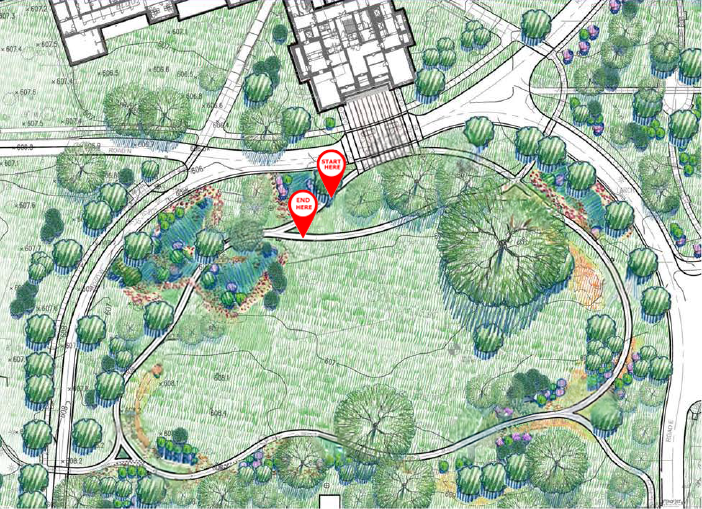
Originally grounds for patients’ recreation and therapy, the open spaces facing Forest Avenue were later converted into parking lots. In 2013, these grounds were reimagined into the South Lawn you see today, which strived to create a landscape that Olmsted himself would create.
Sustainability was important to the Richardson Center Corporation as the South Lawn was renewed, and it continues to be as the Richardson Olmsted Campus is rehabilitated. Rain gardens, like the ones surrounding you now, are another important addition that enhances sustainability. Environmentally friendly, rain gardens reduce storm-water drainage, a seldom considered but important function. The kinds of plants chosen for these gardens are natural to the area and so are easy to maintain. Finally, when the parking lots that covered this entire area were removed, they were ground up and used to create the pathway on which you are currently standing. It was a sustainable move that saved them from becoming landfill!
To continue the tour, walk along the path towards the Towers Building until you reach the bridge.
STOP 12. The Natural Environment and Thoughtful Sustainability
Stop Number 12—The Natural Environment and Thoughtful Sustainability
Location: The Bridge and gardens
The rain gardens around where you are standing include only plants native to the area. This reduces the need for excessive care, costly maintenance, and regular or organized gardening. Given the diversity of Buffalo’s weather, native plants weather seasonal changes as well as Buffalo’s hearty residents!
During a heavy rain, stormwater normally runs off surface lots and paved areas into the sewer. When the sewer gets too full, it overflows and pumps the overflow into the lake. However, rainwater is not all that is pumped into the lake—sewage is as well. Rain gardens channel excess water into the earth instead of into the sewer, helping to keep the system from overflowing. Therefore, in addition to their aesthetic value, rain gardens have a useful, and sustainable, function.
Everything on this site worked together to create an environment to calm as well as stimulate the patients’ minds. The Kirkbride Plan was revolutionary for treating patients kindly. Instead of containment, it emphasized physical and work therapy, socialization, and a balance of nature and treatment. The architecture and landscape of the site worked together to achieve those goals.
This bridge can be seen as a symbol connecting the Richardson Olmsted Campus to the wider community, both in the past and present. All who are involved with this great project encourage the community to visit the gallery on the first floor of the hotel to learn more about the site’s history.
To continue the tour, walk north along the path towards the Towers Building until you reach the fork in the road.
STOP 13. Modern Uses for a National Historic Landmark
Stop #13—Modern Uses for a National Historic Landmark
Location: Fork in the path
Many community members have worked hard over the years since the site’s closure to save the Richardson from threatened demolition. In 2006, the nonprofit Richardson Center Corporation was formed to create and execute a reuse plan.
Since then, the Richardson has undergone a multistage rehabilitation and reuse process: stabilizing the buildings, reconstructing elements, and renovating interior spaces.
The preservation of the Richardson Olmsted Campus is a rehabilitation, not a restoration. A restoration is when a site is restored to a certain point in time. Examples of restoration in Buffalo include the Theodore Roosevelt National Inaugural Site and the Darwin Martin House. A rehabilitation is when the site is preserved and then adapted for new uses.
The Richardson Center Corporation, which oversees and administers the process, continually consults with the New York State Historic Preservation Office and the National Park Service on their reuse plan. The public has been actively engaged in these processes through a Community Advisory Group and public meetings.
The first redevelopment project at the Richardson involved rehabilitation of the main Towers Building and the first wing building on each side of the Towers for use as the Richardson Hotel. All other buildings have been mothballed for development in future phases as part of a mixed-use Campus potentially envisioning artistic, residential, academic, and cultural uses and amenities for the City of Buffalo.
The following resources will give you more information about the historic preservation of the site. They can be found on our website, www.richardson-olmsted.com. A Master Plan for development details the reuse phases, a Historic Structures Report chronicles the history of the architecture and the condition of the buildings before rehabilitation, and a Cultural Landscape Report deals with Olmsted’s design and the landscape renewal details.
If you take a moment to read the plaque located on a stone to your left as you approach the Towers Building, it states that the Buffalo Psychiatric Center, the former name of the Richardson Olmsted Campus, is a recognized National Historic Landmark. Landmark status is the highest designation given to a building, site, structure, or object deemed to have outstanding historical significance. The Richardson was designated in 1986.
Only 2,500 sites across America have been recognized as National Historic Landmarks, and 8 of them are located right here in Buffalo!
The other 7 are:
- The Buffalo History Museum
- The Edward M. Cotter fireboat
- The Darwin D. Martin House
- The Guaranty Building
- Kleinhans Music Hall
- St. Paul’s Cathedral
- The U.S.S. The Sullivans
Notice that the plaque is mounted on a reddish brown stone. This type of stone, used on many of the buildings at the Richardson, is Medina Sandstone quarried near Medina, New York. It is one of the building materials for which Buffalo architecture is known. You can see examples of it used on buildings throughout the United States.
To finish the tour, head towards the raised map of the Richardson.
ENDING POINT. Visit Us Indoors!
Ending Point — Visit Us Indoors!
Location: Back by the map
We hope you have enjoyed learning about this amazing place that contributes so richly to Buffalo’s cultural heritage! We’re excited to share the past, present, and future of the Richardson with our visitors, and it’s been our pleasure to share it with you. If you are interested in seeing the untouched interiors of the Richardson, join us on one of our public or private tours, offered seasonally each year. You can find information about these tours on our website: www.richardson-olmsted.com.
We would love to hear about your experience! You can email your thoughts to us at info@richardson-olmsted.com.
Again, thank you for your interest in the Richardson Olmsted Campus. We would like to invite you to explore our South Lawn and enjoy this reclaimed green space.